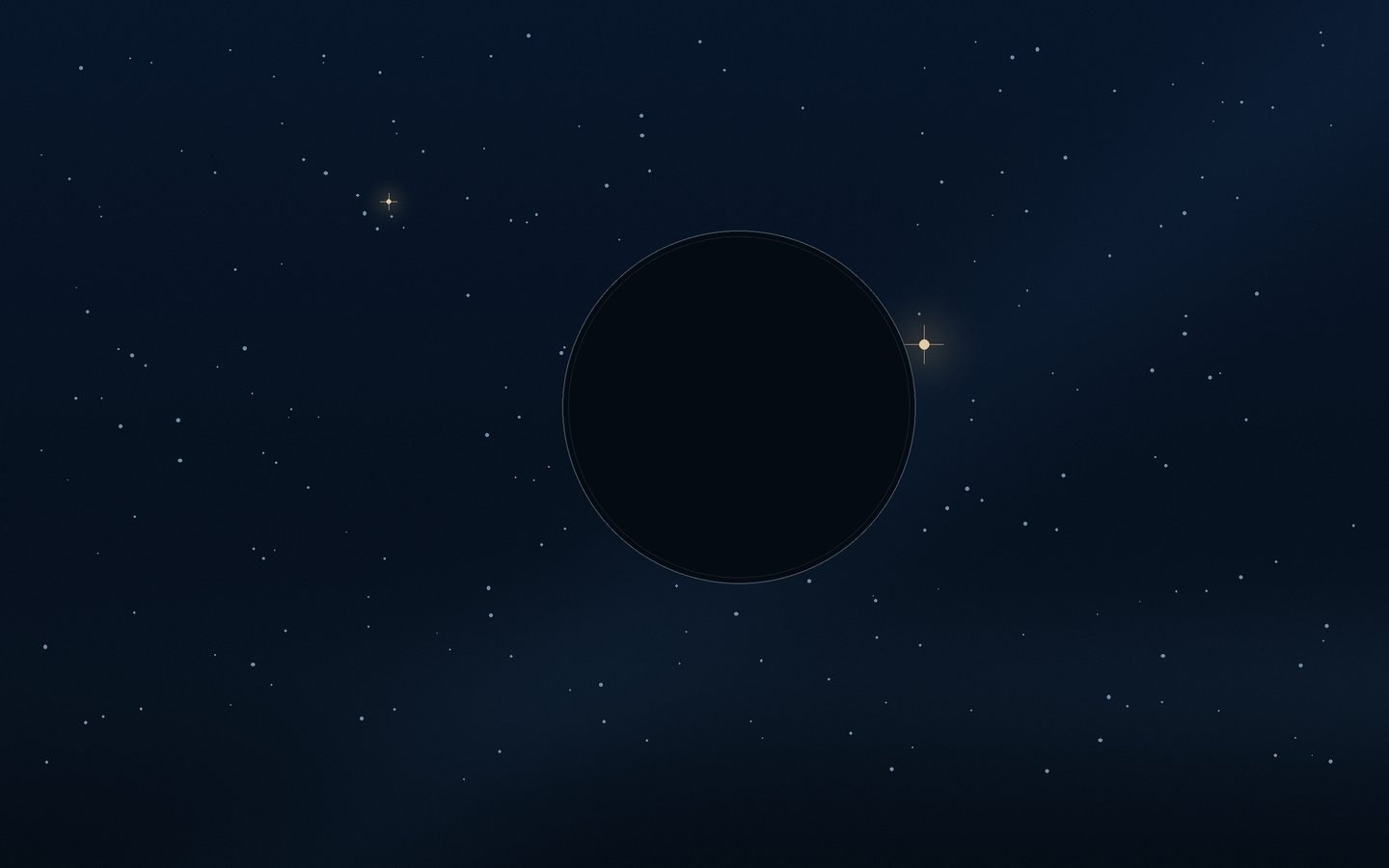
An occultation turns a distant star into a probe of a nearer world. When the Moon, an asteroid or another Solar System body moves across the line of sight, the star's light changes. The useful observation is more than a view of something disappearing. It is a record of when the light changed, where the telescope stood, and how confidently that change can be measured. This guide follows those questions from the sky to the clock and from the camera to the report.
IOTA's explanation of occultations describes a nearer Solar System body hiding a more distant object and emphasises that the event is visible only from a limited region of Earth. That geographical restriction gives the subject its practical character. A promising event can require travel, coordinated sites and careful preparation. A bright target may be easy to find, yet the observation still depends on being in the right place with a trustworthy time reference.
A precise time gives the shadow a scale
For an asteroid event, the interval between disappearance and reappearance describes a passage through its projected shadow. Combine that interval with the shadow's motion and the telescope's position, and the timing becomes a measurement across the body. Observers spread across the path supply different cuts through the same outline. The page on asteroid chords and observing stations explains how those cuts fit together and why a clear miss can constrain the edge.
IOTA's observing basics state a goal of 0.1 seconds or better with respect to UT for most lunar and asteroid occultations. A clock can display finely divided time without meeting that goal. The display may be late, a camera may label an exposure at its end, or a recorder may omit images. Knowing what a time label refers to matters as much as reading its digits.
Separate the reference clock from the rest of the measurement. The reference establishes the time standard. The camera collects light over an exposure interval. The recording system preserves the images and their labels. Analysis then estimates where the change occurred within that sequence. A dependable result needs an understood relationship between all of these stages, rather than an assumption that a familiar clock display proves the whole chain.
The changing light has a shape
The Moon provides a conspicuous starting point. A star approaching the unlit limb can vanish against a dark background; near the lunar edge, mountains and valleys can make it blink repeatedly. Asteroid events usually involve watching a selected star while an object too faint to notice passes in front of it. Distant bodies extend the same method to questions about rings and atmospheres. These are related observing tasks, but their practical demands differ.
IOTA's account of why observers time occultations includes asteroid sizes and shapes, possible satellites, stellar companions and the lunar limb among the scientific contributions. The value comes from interpretable evidence. An unusual dip deserves investigation, but its appearance alone does not establish a moon or a ring. Comparison stars, equipment checks and observations from other sites help separate the astronomical signal from local problems.
A light curve brings the brightness measurements into view against time. It helps reveal whether a drop is abrupt, gradual, shallow or lost in noise. Keep the original images alongside the graph: tracking changes, cloud and background light can explain features that seem convincing when viewed as isolated points. Brightness measurement and timing work together because the event boundary must be found in the recorded light.
Prepare the observation before the deadline
Begin with the target and observing geometry. Confirm the star field, study the predicted path and check that the chosen site offers a usable view. Next rehearse the equipment in its intended configuration. Establish valid clock status, focus the star, choose a suitable exposure and make a trial recording. Verify that the resulting file contains the expected images and that their timing information can be read. This rehearsal makes unfamiliar behaviour visible while there is still time to investigate it.
During the observation, preserve a useful stretch of steady light around the event window. Avoid changing settings at the critical moment. Afterwards, record what actually happened, including interruptions and uncertainty. The guide to turning a recording into a report explains how to present the result so it can be combined with other stations. A report of uninterrupted starlight can be useful when the star remained measurable throughout the relevant interval.
The pages below can be read in order from observing geometry through timekeeping and video, or used to solve a particular question. The telescope and observer pages address the field conditions that make the measurement possible. Each topic keeps attention on the practical question: what does the equipment or observing choice allow the result to say?
The Occultation Timekeeper is an independent guide to observing and timing occultations. It is not affiliated with, endorsed by, or connected to Kuriwa Observatory or its owner, the International Occultation Timing Association, or any maker of the equipment or software described here. It sells nothing and offers no equipment, kits or services.
Explore the guide
Occultations
- Asteroid occultations: chords, shapes and a line of observers — Read a shadow path and understand the value of coordinated stations.
- Lunar occultations and grazes — Follow total events and the repeated blinks caused by the lunar limb.
- Finding asteroid moons by occultation — Assess an extra dip and the evidence needed for a satellite interpretation.
- Occultations by distant worlds: Pluto, TNOs and Centaurs — Explore atmosphere and ring measurements beyond ordinary asteroid work.
- Asteroid occultation predictions: how event feeds work — Use forecast fields, path uncertainty and observing circumstances to choose a target.
- Short events: small asteroids and bright stars — Balance a brief shadow crossing against sensitivity and time resolution.
- Reading a light curve — Interpret brightness changes while retaining the evidence in the images.
- From recording to report — Present event times, uncertainty, equipment and useful negative observations.
Time
- How accurate is internet time? — Distinguish network synchronisation from a verified timing signal at the telescope.
- Leap seconds and the observer — Keep UTC, atomic time and clock behaviour distinct.
- Listening to time: beeps, pips and radio signals — Understand the path between a time signal and an audio recording.
- GPS clocks for visual observers — Combine a valid GPS time display with audible markers and an observation record.
- Judging the quality of time — Compare clock outputs while checking their independence and meaning.
- Powering field equipment safely — Plan protected battery connections and orderly handling at a dark site.
- Video time inserters: writing GPS time onto analog video — Relate the time overlay to video fields and equipment status.
Video
- Digital video for occultations: every frame stamped with GPS time — Relate frame labels to actual exposures and the gaps between them.
- Recording software and file formats: where the timestamp lives — Follow timing metadata and distinguish display adjustments from saved measurements.
- Hardware timers: tying each frame to the GPS second — Connect an external timing reference with exposure triggering or tagging.
- Choosing a camera for occultation work — Consider sensitivity, field of view and the way a sensor reads light.
- Controlling an analog video camera from a computer — Manage gain, integration and gamma with stable field operation in mind.
- Is your camera linear? Response testing for light curves — Examine how brightness encoding affects a photometric measurement.
- Verifying timestamps with a flashing LED array — Test the relationship between recorded light and its time label.
Telescope & observer
- Building a small Dobsonian reflector — Understand mirrors, focal ratio, testing and a simple observing mount.
- The observer's body: reaction time, night vision, posture and cold — Consider the human demands of an observing session.
About
- About The Occultation Timekeeper — Read the guide's scope, organisation and independence notice.