A lunar occultation uses the Moon's moving edge to cover or uncover a distant star. The target is close to a conspicuous object, so finding the right part of the sky is often easier than locating an isolated asteroid-occultation star. The observation still calls for preparation: identify the star, understand which limb it will meet, establish a time reference and record the change. A successful timing is a statement about the event at the telescope's actual position.
IOTA's introduction to lunar occultations presents them as a useful training task for inexperienced observers and those with small telescopes. A total event is a sensible place to learn target identification, timing and reporting before attempting the more complex sequence of a graze. The familiar Moon provides orientation, but its brightness also means that the predicted event geometry deserves attention before the session begins.
Watch the correct edge
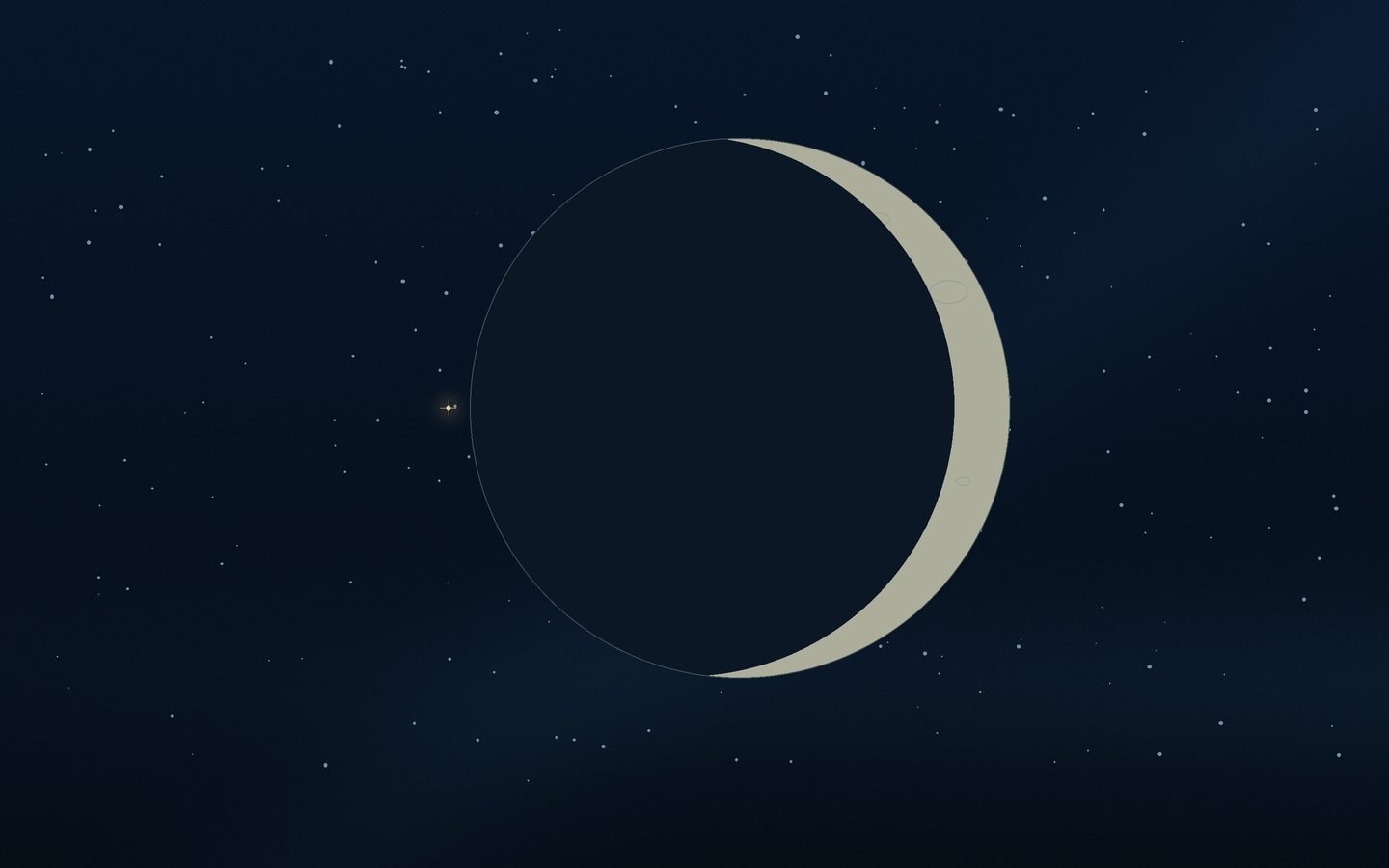
The limb is the apparent outline of the Moon. At the dark limb, a star can be followed against a relatively unlit background until it vanishes. On the bright limb, glare can make the star harder to distinguish. The lunar phase and whether the observation concerns disappearance or reappearance determine which edge is relevant. Do not treat an attractive crescent as enough information: use the predicted contact position to identify the part of the outline being watched.
A disappearance allows the observer to follow the star beforehand. A reappearance requires attention to the expected position before the star becomes visible. With a camera, frame the relevant area early and test whether the star or nearby reference field is recorded adequately. Keep the image stable rather than chasing the limb at the event moment. A recording that continues smoothly through the change gives analysis a useful view of the circumstances.
Exposure and gain choices should preserve the target signal without making the bright lunar surface dominate the image. The optimum view depends on the particular star, phase and field. Test the intended settings on the actual scene when possible, and do not infer timing reliability from the apparent sharpness of the Moon. An impressive lunar image and an interpretable occultation measurement ask different questions of the recording.
Total events and grazing sequences
For a total occultation, the line of sight enters the Moon's projected disc or leaves it. The event being timed is the relevant transition. The lunar outline is not perfectly smooth, but away from the path limit the star is fully hidden behind the Moon. This makes a total event easier to follow than a sequence of brief disappearances near the edge, and gives a beginner room to practise the reporting method.
Wikipedia's account of grazing lunar occultations describes a star disappearing and reappearing intermittently at the lunar edge. Mountains block the line of sight while gaps in the limb allow the star to show again. The apparent passage is a sampling of lunar terrain. A graze is therefore a sequence to record continuously, rather than an isolated expected blink that can be marked and then forgotten.
Small changes in observing position can change that sequence. A station closer to the shadow interior may see more complete obstruction, while a station farther out can see an uninterrupted star. Coordinated observers placed across the predicted limit sample different parts of the limb profile. Plan the actual telescope positions, keep their location measurements, and identify any move made after the initial site selection. The timings need those positions to describe the lunar edge.
Choose a timing method before observing
A visual observer can make an audio record that includes spoken event markers and a time signal. A portable GPS clock for visual observing can supply a display and audible reference, provided its status and output have been checked. The spoken marker is part of the measurement method; label it as visual timing rather than presenting it as the exposure boundary of a camera.
Video provides a sequence that can be examined afterwards. An analog video time inserter relates an on-image time label to the video signal. The operator still needs to know what that label marks and how integration affects the image. For a busy graze, preserve the sequence around all the transitions, including doubtful dimmings. Do not simplify a complex recording into a tidy event list by silently omitting uncertainty.
Rehearse the chosen method. Confirm that the target area remains within the field, the time reference is valid and the saved recording can be played or analysed. Begin early enough to establish ordinary star brightness before the predicted window and continue beyond it. Record cloud, tracking problems, interruptions and setting changes. These details help explain why a transition is clear, doubtful or unavailable.
Make the report match the evidence
IOTA's observing basics identify event times as the central measurement and describe reporting analysed observations to a regional coordinator. A lunar report should make the telescope position, event type, time reference and measurement method clear. Include uncertainty and anything that obscured the star. A graze report needs the observed sequence, with ambiguous transitions identified instead of assigned artificial certainty.
The page on moving from observation to report explains how to keep the recording, analysis and final result connected. A negative result should state that the star remained measurable during the relevant interval; an interrupted observation should state the interruption. Learning that distinction during total lunar events establishes sound habits for grazes and asteroid work alike. The aim is a result that another observer can interpret without guessing what happened at the telescope.