An asteroid can hide a star without ever becoming visible in the telescope as a separate object. A moon travelling with the asteroid can do the same. The resulting extra dip may appear before or after the main occultation, or at a station outside the main shadow. This makes a complete recording valuable: watching only the expected main event can discard the feature that deserves the closest investigation. An unexpected dip is a candidate signal, however, rather than an automatic discovery.
IOTA's account of occultation contributions includes identifying possible satellites around asteroids. The qualification matters. A dip can come from the sky, equipment, measurement choices or the target itself. The task is to establish what the observation supports before naming its cause. Save the complete images and timing information, retain the surrounding steady signal, and describe the feature without turning a suggestive interpretation into a settled result.
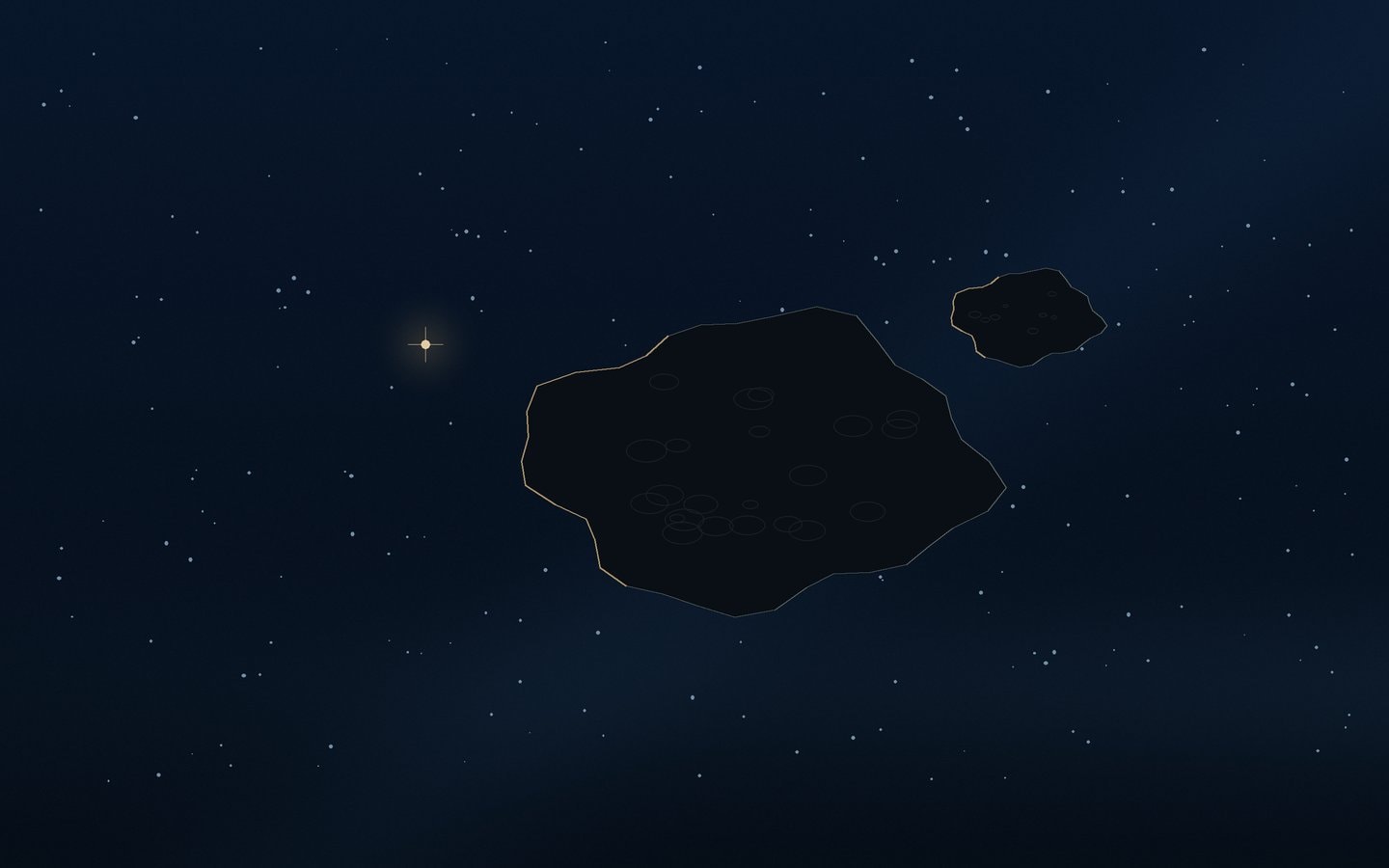
What an extra shadow would look like
A satellite's projected shadow is displaced from the asteroid's main shadow. The paths sampled by observing stations therefore need not encounter the same components. A station may see the asteroid and an extra event, only the main event, or no main event at all. The order and spacing of changes reflect the projected geometry and relative motion. These possibilities make location and absolute timing especially important when comparing unusual features across sites.
Study the event in its original image sequence. A true reduction of the target's light should remain plausible when the measurement area and background estimate are inspected. Check whether the star moved, became blended with another image, or approached the edge of the frame. A graph alone can conceal those problems. The page on reading a light curve explains how the measurements and images support each other.
Wikipedia's discussion of occultation light curves notes that double occulting or occulted bodies can produce a stepped change in brightness. A complicated shape is therefore not unique to an asteroid moon. A stellar companion can also alter an event's appearance. Integration and noise can blur the distinction between a separate dip, a step and an uncertain fluctuation. Record the actual shape and its uncertainty before deciding which physical explanation fits.
Ask what else changed
Cloud affects light from other stars as well as the target, although not always identically across a field. A tracking disturbance changes where images land. A recording gap can look abrupt if the time axis is assumed to be continuous. Camera settings can change the background or target counts. Examine neighbouring stars, image positions and frame timing around the candidate feature. Evidence against these explanations is stronger when the relevant checks can be shown, rather than merely asserted.
A shallow signal demands stable measurement. If the star is saturated, a brightness drop may have a distorted shape. If the background estimate crosses an uneven patch, the measured star signal can move without a real occultation. Repeat the analysis with sensible measurement choices and keep track of what changes. A feature that depends on a narrowly chosen processing setting deserves a different confidence statement from a feature visible consistently in the images.
The expected shadow from a small satellite can be brief. Review the trade-off between exposure length and sensitivity described for short events. A longer exposure collects light more effectively but averages whatever happens during it. Gaps between exposures can leave a short event only partly sampled. The observation can constrain a satellite interpretation only within the depth and duration range the equipment could actually detect.
Independent stations test the geometry
A matching feature at another station is valuable because cloud, pointing errors and local electronics are unlikely to repeat with the appropriate shadow geometry everywhere. Agreement must include credible clocks and the correct targets, rather than a visual resemblance between graphs. Compare event order, absolute times, durations and site positions. The same physical shadow can produce different intervals at different cross-path positions; exact duplication is not the necessary test.
Clear negative observations also constrain the possibilities. A station that monitored the relevant interval without a detectable dip can limit where the candidate shadow crossed. State the sensitivity and any interruptions before using such a result geometrically. The guide to asteroid chords explains how positive chords and misses bound an outline. That reasoning extends to a possible companion, with extra care about which component each event belongs to.
What a confirmed companion can add
Wikipedia's minor-planet moon reference explains that determining satellite orbits can provide estimates of a primary body's mass and density. An occultation candidate contributes to that larger investigation; it does not by itself supply a complete orbit. Later observations may confirm a companion and help constrain its movement. Keep the distinction between detecting an extra obstruction and describing a gravitational system clear.
The final observation report should include the candidate's timings, uncertainties, recording circumstances and alternative explanations examined. Preserve doubtful signals as doubtful signals, with the supporting material available for analysis. Report a well-observed absence honestly as well. The useful contribution is an independently interpretable record that can be compared with other stations and future events, whether the satellite interpretation survives or is replaced by a simpler explanation.