A distant body can be too small in apparent size for an amateur telescope to show its outline, yet its passage in front of a star can reveal that outline indirectly. The star supplies a compact background light source. Changes in its light mark the body's edge and can also reveal material around it. For Pluto, trans-Neptunian objects and Centaurs, careful timing and brightness measurement extend the occultation method to worlds that are difficult to study directly from Earth.
The bodies behind the names
A trans-Neptunian object, usually abbreviated TNO, is a minor planet orbiting the Sun at a greater average distance than Neptune. Pluto belongs to this distant population. Centaurs occupy the region between Jupiter and Neptune, with orbits that can cross those of the giant planets. These names describe orbital populations rather than a guarantee that their surfaces, sizes or surrounding material are alike. An observing plan must use the circumstances of the particular target.
The basic geometry remains familiar from asteroid occultations: each station samples a track through a projected shadow. Distant targets add practical challenges. Their apparent discs are small, and the star may be faint. The observer may need substantial light collection while retaining enough time resolution to describe the transition. A failure to detect a feature means little without knowing which changes the recording could have shown.
Pluto's atmosphere changes the transition
Wikipedia's reference on Pluto's atmosphere describes Earth-based stellar occultations as a method used to study that atmosphere. An airless opaque edge tends to give a sharp disappearance, whereas Pluto's atmosphere can make the light decrease gradually as refraction redirects it. That changing signal contains more information than an isolated time of disappearance. Its shape needs a stable measurement of light through the transition.
Do not assume that every smooth decline demonstrates an atmosphere. A long exposure averages a sharp change, and varying transparency can produce a gradual trend. Compare the target with suitable field stars and check the exposure timing. Analysis of an atmospheric event asks how the brightness evolved as well as when it changed. A recording must preserve the surrounding baseline so that the apparent decline is judged against the ordinary noise and sky conditions.
The page on light curves explains the connection between photometry and timing. For a gradual event, forcing a sharp-edged model onto the data can hide the feature being studied. Retain the measured shape and make the analysis assumptions explicit. A detailed atmospheric interpretation depends on a physical model and coordinated evidence; a clear amateur recording contributes measurements to that work without needing to claim a complete atmospheric description.
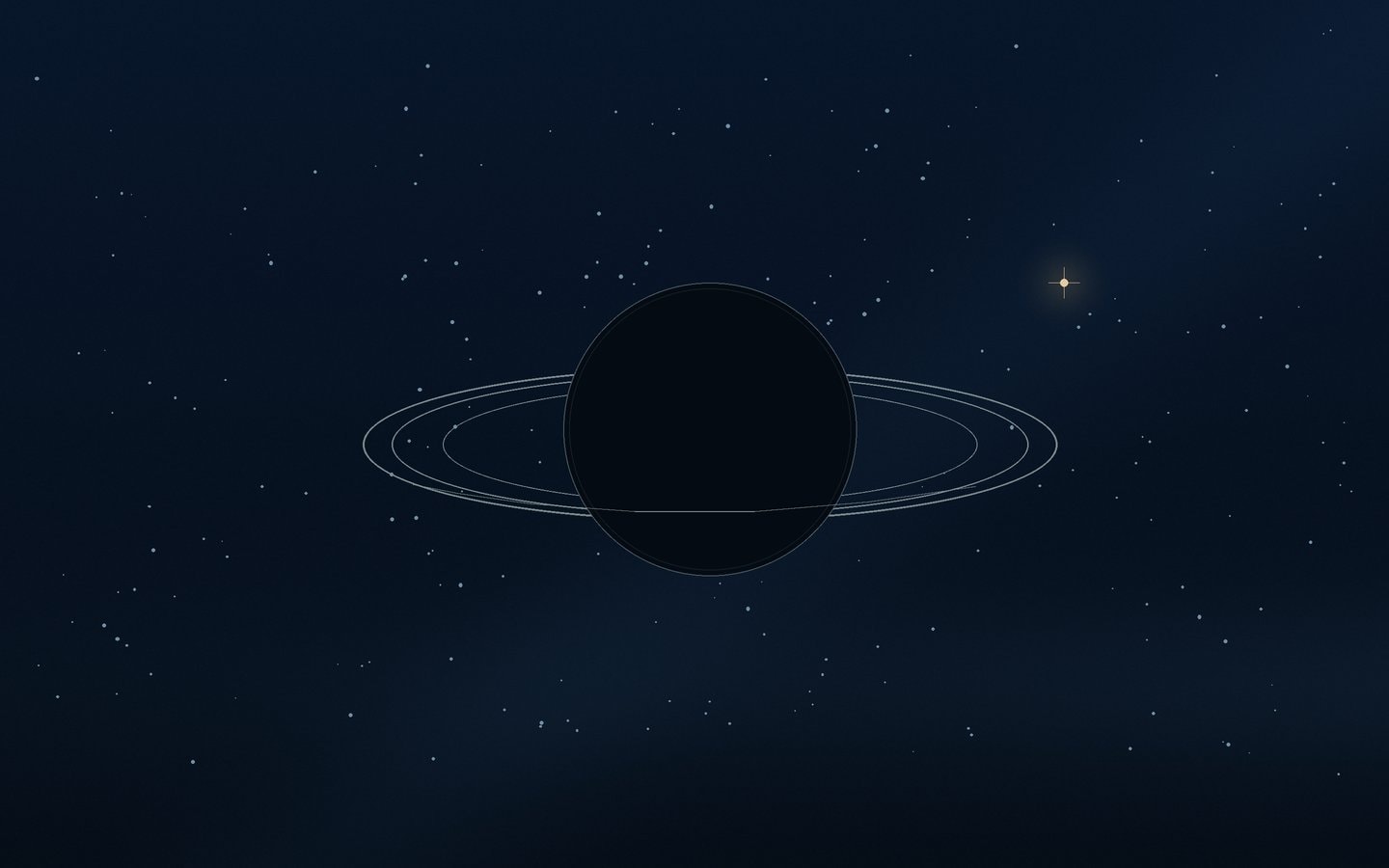
Chariklo showed material beyond its disc
Wikipedia's account of Chariklo's rings describes their discovery through a stellar occultation. The main body's event was accompanied by additional reductions in starlight. Comparing these features from different observing locations helped establish a ring interpretation. The example shows why the recording around an expected main event deserves attention, rather than being treated merely as spare footage before and after the important part.
Rings introduce extra crossings of the line of sight. Their appearance depends on viewing geometry and on the path sampled by a station. A dip outside the main event can also have other explanations, so preserve the original images and compare independent observations. A ring claim needs the geometry to agree across sites. Repeated features in a well-understood timing sequence are more informative than an isolated fluctuation with an uncertain clock or background estimate.
A prediction needs both body and star positions
To predict an occultation, the apparent track of the foreground body must be compared with the position of the background star. Uncertainty in either changes where the shadow is expected to pass. For a distant object, a small error on the sky can correspond to a substantial shift at Earth. A path line should therefore be read with its uncertainty region and with any later refinement, rather than as an exact route guaranteed to cross the chosen telescope.
Wikipedia's Gaia mission reference describes astrometry as measuring stellar positions, distances and motions. More dependable star positions address the stellar part of an occultation prediction. The practical inference is that a better reference star position can sharpen that ingredient; it does not eliminate uncertainty in the foreground body's orbit. Treat the prediction as the combination of those inputs, and preserve its stated uncertainties when choosing stations.
Plan a useful contribution
Read the guide to prediction feeds before selecting a distant-world event. Check target identification, sky visibility, expected brightness change and the useful observing interval. Spread stations in relation to the path uncertainty and the feature being sought. An atmosphere study may prioritise a well-measured transition; a ring search also needs useful coverage outside the main shadow. Agree on the recording window and timing checks in advance.
After the observation, retain both event and negative results with their limits. State the telescope location, time source, exposure settings and interruptions in the report. Distinguish a measurable absence of a dip from poor sensitivity or missing coverage. The strength of distant-world occultation work is the combination of independent stations: each offers a different line of sight, while a common time reference lets those lines describe the same passing world.